Friday, December 1, 2017

Catholic marriage separation, permission and sin.


Commentary on Canon 1153+1154


Can. 1153 gives one spouse the authority to separate on own authority if there is danger in waiting for the requisite permission from the local ordinary. Permission to continue living apart must then be ecclesiastically pursued, or the prolonged de facto separation becomes the grave sin of public abandonment, no matter how privately just the cause may be. Public/canonical abandoners are not eligible for Communion.

Canon 1154 says that the parents must provide for the children and educate them in the faith. Therefore, the separating spouse may sue on own authority only for emergency child support in civil court, but never for separation. No spouse may sue for separation ("divorce") w/o first obtaining the bishop's permission - or it's public grave sin.

Description:The 3rd Council of Baltimore decree #126 states that: "We command all (i.e. baptized) married persons that they must not go to the civil courts to obtain a separation from bed and board without previously receiving permission from the ecclesiastical authority. Should anyone attempt this, let him know that he incurs the guilt of grave sin and that he is to be punished as the bishop shall decide."

This legislation remains in force per Canon 6.1n.2.


Sunday, November 26, 2017

Card. Cocco & Ed Peters airbrush divine law, spread divorce heresy.


Cardinal Coccopalmerio and Ed Peters, responding to political pressure, are the first ever to publicly flip 180 degrees from centuries-old Church discipline and state that bishop's permission is not required for divorce due to the absence of government concordat. To hold such a position is heretical b/c it denies that the marriage contract (not just the bond) belongs to God. What they are both ignoring is the fact that divorce involves natural/divine law (CCC 2384)Pope Leo XIII and Fr. John Beal explain that the marriage contract is a matter of natural/divine law. Ed Peters and Card. Cocco are saying it is not. Can. 1692 establishes that the divorce sentence (split the baby) must not be "contrary to divine law." The civil sentence is usually evil which is why a trusted source (bishop or benign state) must ensure justice beforehand. Divorce and separation are canonical issues. Personal conscience is never adequate to adjudicate one's own case and ensure equity. The Catholic divorce do-it-yourself discipline has gotten so bad in the West that Peters and Cocco's politically correct explanation/solution is gladly accepted w/o question as gospel by most. After all, who wants to be the bearer of some truthful but radically bad news? Don't ask, don't tell.

Monday, August 21, 2017

Jennifer Roback Morse Ad Hominem?


       Dr. Jennifer Roback Morse of the Ruth Institute has requested that you ignore me - "and I do mean ignore" me.

She says I am rude. Is that really it? I am a certified nobody - why bother blogging about little old me and my bad manners?

No, I submit that it's because I persistently raise a direct question that makes Dr. Morse (and almost everybody else) politically uncomfortable.

Are all permanent separation of Catholic spouses properly by bishop's decree only?

Do all Catholic spouses require the bishop's permission to file for divorce?

The questions are one in the same, because they hinge on marriage natural law.

It is a grave offence against natural law to permanently separate unjustly (CCC 2384).

It is an axiom of law that one may not be the judge of one's own case - hence need for bishop's decree/permission.

Ed Peters effectively says no permission required b/c the conjugal life has zero to do w/ natural law. And if that does not square with you, then he offers that Pope John Paul II meant existing canon laws requiring decree/permission to be only "symbolic" - that explains why nobody follows them around here, you see? There is a reason why the status quo will not take further questions.

Dr. Morse says "I am not going to make a pronouncement on this topic, as I am not qualified to do so." One could say they are not qualified to make a pronouncement about abortion without a PhD in biology + a degree in moral theology. Why does one need to be an accomplished canonist to know marriage basics?

To not decide is to decide. In this case, that means to side with the status quo - no permission required. The American Catholic practice default is No-Fault; almost always a violation of natural law, bringing profound suffering to the innocent. The divorce/annulment culture transfers their crosses to these innocent. "Don't ask, don't tell" is the vigorously enforced canonical agnosticism in the USA. To go against this does not sit well in polite Catholic company.

Dr. Morse has made a "pronouncement," that I am rude and that I am not "helping [my] cause," but will not say whether I am right or wrong, so how could she know? Shut up, they explained..

Ad hominem says "I have no argument, so I attack you instead."

If canon law is "not for the faint of heart," than I ask Jennifer Roback Morse, PhD to Joan up, rather than try to have me shut up.


-John Farrell


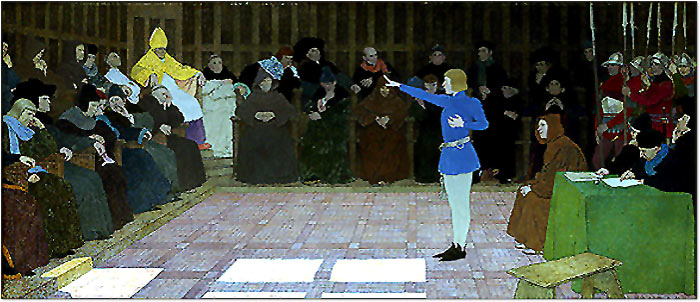
Painting by Louis Boutet de Monvel in 1911 of Joan of Arc at trial before her judges titled:          "The Trial of Joan of Arc"
Thursday, July 27, 2017

The status quo (Ed Peters) fights back


Recently, Ed Peters responded to a piece in 1Peter5 which exposed the don't ask, don't tell policy of the English-speaking Church when it comes to proper meaning and practice of the separation canons (1151-1155 and 1692-1696). To me, he seemed displeased with the author (Clay Rossi) for pointing out the fact that divorce lawyers cannot bank on which spouse is acting "contrary to justice," since the local Church has shirked her responsibility to adjudicate spousal separations and has instead outsourced all to the civil forum, whether the separations are in accord with divine law - or not. Or maybe it was because Rossi hit the nail on the head when he exposed what is really going on with the American hierarchy: the "tried and true avoidance mechanism of  'don’t ask, don’t tell.'" Ouch.


Ed Peters says:


"That is the precise point at issue, whether bishops have to issue such rulings in the first place!" Correct. What is the answer? It is of course "yes," permission is required. But Ed says "no," it is not required. He says that it is wrong to conclude that "these (universal permission for divorce) norms must be applicable everywhere. 


Ed Peters apparently thinks that only canon lawyers can make any conclusions about Church law regarding permission for divorce. Better leave this to the professionals..


Your average beer drinking rock-n-roll Catholic can read the commentaries on canon law by the bestand brightest"Since divorce laws have proliferated (in the USA)..the bishop's authorization is a necessary precaution.."


Don't ask, don't tell is Ed Peters M.O. when it comes to this question. 


Why do I say this? Because the "no permission required" crowd has no argument. So far, Ed Peters has put forward that everybody is ignoring it, so that makes it OK, and that it's wrong for Americans to feel obligated to follow the law, therefore JP2 really meant that the canons must be merely "symbolic." Neither of his assertions can be defended, so his only defense is silence. The more he speaks on this topic, the more his position crumbles as he gets backed into a corner.


Here are a few questions:


1. Is the legal axiom "no one may be the judge of their own case," true?


2. Did the authors of 3rd Council of  Baltimore. #126 (permission to divorce or grave sin) mean for it to be "symbolic" as well? Has human nature or marriage changed since the council?


3. Is said legislation null and void simply because everybody ignores it?


CCC 2384 says that it is a "grave offense against natural law" for spouses to break the "contract" to live together. Not good.


4. Since No-Fault divorce is almost always a grave offense because one spouse forces an injustice on the other, shouldn't all the tribunal websites be amended to explain that actually not 100% of divorcees are eligible for Communion without a firm purpose of amendment? (return to common life or obtain separation decree from bishop)


Clay Rossi has put his finger on the elephant in the living room - marriage is a contract and a bond. The "no permission required to divorce" crowd focuses on the bond only, while confusing mere civil effects with those which flow directly from the essence of marriage. Planned Parenthood does not want to talk about the baby and Ed Peters does not want to talk about the contract, but Pope Leo XIII does. For a Catholic divorce lawyer to do things right, it must be judged by the Church which spouse is acting justly and which one is not (CCC 2386). Today we have Catholic marriage near-anarchy and plenty of decrees of nullity to bury the "problem."


-John Farrell

Saturday, May 20, 2017

Ed Peters on permission to divorce: John Paul 2 must have meant canons were "symbolic."


Image result for ed peters


Ed Peters currently holds the Edmund Cardinal Szoka Chair and his canonical opinions carry more weight by far than any of his peers. He is the heavyweight champion and when he speaks, he wins. He recently wrote an article here explaining why Americans do not need the local bishop's permission to divorce. He writes: "Canons 1151-1155 of the Code of Canon Law state that Roman Catholics wishing to separate (permanently) from their spouses must obtain ecclesiastical permission for the cessation of conjugal life. Canons 1692-1696 set forth the procedure for obtaining that authorization." Because he is too knowledgeable to misinterpret, he openly admits the plain meaning of the canons - that they do require the bishop's permission to divorce.

                                                              -  however  -

He concludes by saying that Americans may safely ignore these laws because John Paul II likely meant them only "symbolically." According to Ed Peters, the pope "apparently" meant them to be symbolic because nothing else makes any logical sense to Peters. This is because he incorrectly believes that the common conjugal life of spouses + children is a MERE civil effect of marriage, to be adjudicated by the state. (New Commentary of Canon Law pg 1255 refutes him).


 Just because the state can touch it, does not mean the state may touch it. The Church says "hands off" except for the mere civil legal status (Can 1059). Ed Peters, Cardinal Coccopalmerio, the US bishops and Martin Luther all tell the state "hands on." Instead, what should be happening is that only after the bishop determines that the cause is appropriate for the state enforcement, may the spouse go ahead. (can. 1692)

Pope Leo XIII in Arcanum #23 said that it is a "deception" to separate contract from bond and hand the marriage contract to the state (for divorce) and the bond to the Church (for annulment). The contract and the bond must remain together! Four years later, the 3rd Council of Baltimore #126 made accommodation for civil divorce, but only with the local bishop's permission. Those who follow Ed Peters' advice and go without bishop's permission "incur the guilt of grave sin."


 Questions for Ed Peters:


1. Did the bishop authors of 3 Balt. #126 mean for it to be "symbolic" as well? 


2. If JP II meant for canon 1692 to be symbolic, does that mean that 3 Balt #126 has only been      symbolically abrogated? (Can. 6.2 does not abrogate)


3. Is a "symbolic" canon even a thing? 


"Universal laws bind everywhere all those for whom they were issued." (Can. 12)


R
egarding the separation canons which Ed Peters concludes must be "symbolic," John Paul II stated: 

 "[they are] to have the force of law for the whole Latin Church, and I entrust it to the watchful care of all those concerned, in order that it may be observed... they have juridical binding force, ... they will have the force of law beginning from the first day of Advent of this year, 1983. I therefore exhort all the faithful to observe the proposed legislation with a sincere spirit and good will in the hope that there may flower again in the Church a renewed discipline."


Can. 18 "Laws which .. contain an exception from the law are subject to strict interpretation." The separation canons contain this exception.


 Ed Peters says "some people coming across these canons understandably, but wrongly, conclude that, like most other canons in the Code, these norms must be applicable everywhere." 

They are applicable universally because unjust separation of spouses is a grave sin. 
CCC 2384.


Only the local ordinary is to determine just cause. It is an axiom of law that no one may judge their own case. All separations are to have a promoter of justice (can. 1696). Otherwise, the faithful are fed to the No-Fault lions. "does he dare go to law before the unrighteous..? 1 Cor 6


If US bishops started upholding canon law then the Catholic divorce culture would do a 180. Driver's obey the speed limit when police start handing out tickets. Spouses stop separating when they know they must obtain permission from their bishop - or be denied Communion. Any bishop, armed with canon law, could shut down divorce in his diocese in short order. For example, Uganda and Nigeria do not have a Catholic divorce problem because those spouses who separate without permission are denied Communion. The canons bring "law and order." Conversely, ignoring them while multiplying annulments exponentially, perpetuate the problem.

Ed Peters appears to be hoisted by his own petard. A couple of his quotes:

"Sever ‘canon law’ from ‘pastoral practice’ and lots of things make sense." (like DIY separation / divorce)

"Catholics are not free to pick and choose which aspects of Church discipline on marriage they will observe and which ones they won’t." (unless nobody in the USA is following them, then we must explain them away)


Ed Peters recently responded to Bai MacFarlane's rebuttal of his "permission to divorce" paper.  "Roman authorities will certainly reach their (conclusions) in due course." Permission has been required all along and the English-speaking world has simply ignored the law. It is standard procedure for the "annulments trump marriage" crowd to discuss the issue as little as possible and preserve the status quo while banking that Rome will eventually change the law. Ain't gonna happen because wholesale DIY unilateral separation can never square with justice. "Seek ye therefore first the kingdom of God, and his justice.."


This has a lot more to do with Church politics than it does with canon law. If Ed Peters brings the fight to Bai MacFarlane, he will lose. No wonder he does not "see much use in replying."


-John Farrell


Sunday, April 2, 2017

Leila Miller/Catholic Answers get close, but don't deliver needed bullseye re divorce.

+++

Related image

Recently, Leila Miller wrote an article for Catholic Answers: 

Eight Things You Have To Know About The Church's Teaching On Divorce

 In it, she makes many good points while trying to clear up divorce and defend marriage, but unfortunately fails because she does not recognize the elephant in the living room: Catholic unilateral No Fault divorce has illicitly replaced canonical separations in the external forum.

She says: "6. Divorce and separation are two different things

Divorce is an attempt to break the marriage bond.." 

Actually, divorce "claims to break the marriage contract..to live with each other till death." (ccc 2384) Bond and contract are connected but distinct.

The fact is, divorce and separation are one in the same for Catholics. Both have identical effects; the spouses are separated with the bond remaining. The state is real good at violating divine law and allowing the shedding innocent blood. Civil divorce is no exception when the state gets it's hands on the marriage contract, tied to natural law. The sheep are fed to the wolves.

Leila says "As Catholics, we are called to a higher standard than the secular culture.."

But your bishop is leading us with secular culture when it comes to divorce! He has effectively replaced certain canons / disciplines with No Fault divorce. This has been done mostly to invite more annulments vs. any defense of the marriage contract. 

Leila says "when the Church grants an annulment it is not "divorce, Catholic-style." 

In theory, it is not, but with "no questions asked" divorces and all but guaranteed American annulments (CSLA stats), in practice, it is Catholic divorce. If it walks like a duck..

"The one who unjustly divorces his or her spouse is guilty of a grave sin." Exactly. Per canon law, all divorces are supposed to have the innocent spouse and the guilty spouse identified. The one who refuse to cooperate/repent should be denied Communion per canon 915. "the marriage of Catholics is governed .. by canon law." Canon 1059

I invite Leila Miller / Catholic Answers to promote existing Church discipline - that the state has no business adjudicating Catholic marriage contracts and that Catholics have no authority to bring these contracts to civil court, or to permanently separate, without the local bishop's permission first. Because no spouse may judge their own case, to permanently separate/divorce on own authority is "a grave offense against the natural law." 

The Church's teaching on divorce runs counter the practice of 100% of American bishops.  Kinda hard to promote proper Catholic "external forum" and current "don't ask, don't tell" at the same time. Maybe that is why Leila Miller correctly observes "we don’t hear enough about Church teaching on divorce." To do so would beg questions and lead to exposing the living room elephant, which local authority prefers to keep hidden.

-John Farrell